Yogie and Friends in the Shreveport Times
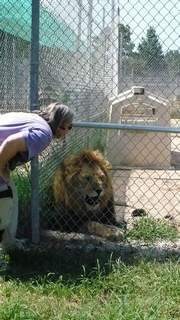
FRIERSON — Three years have passed since a state law regulating the importation and private ownership of big exotic cats went in to effect, but only recently has Yogie and Friends Exotic Cat Sanctuary undergone the inspection for the permitting process to be classified as a sanctuary not accredited by the American Zoo and Aquarium Association. The classification allows the sanctuary to stay open to the public.
Only a few improvements were recommended during the on-site visit by the Louisiana Department of Wildlife and Fisheries. “I think we did well,” Executive Director Jenny Senier said. “The only problem is it will be costly.”
So the call is going out for financial donations. Yogie and Friends is fortunate, Senier said, to have a good team of volunteers who give of their time when projects need to be done at the Frierson location. The public also responds to the various fundraisers sponsored throughout the year.
But she’s yet to put a dollar figure on the LDWF recommendations. “I just know concrete is expensive,” Senier said of the suggestion that a ring of concrete be added at ground level around the perimeter to ensure the big cats’ fenced enclosures are secured to the ground.
Other suggestions were to extend the fencing up to 16 feet to replace the current setup that includes 12-feet vertical and 4-feet overhang and provide either concrete or cinderblock shelters for the animals to replace the calf hutches.
The latter is to protect the lions and tigers during inclement weather — a concern stemming from Louisiana’s sporadic hurricanes. Fortunately, Senier said, none of the animals have been harmed during a weather incident, nor have there been any safety issues involving the public.
“They just want extra precautions and we’re fine with that. We always go above and beyond what we need to do so I’d rather go above and beyond if that’s what they want,” Senier said.
Maria Davidson, of the Louisiana Department of Wildlife and Fisheries Fur and Refuge Division in Baton Rouge, led the inspection team. She was on vacation this week and unavailable for comment.
Davidson told The Times in a previous interview, however, that the intent of the law enacted in 2006 is to ensure public safety and the health of the animals. She cited headline-grabbing stories where people had been maimed or injured by exotic animals because they were allowed to get too close to them.
The same law bans traveling petting zoos and circuses that offer photographs with exotic cats.
Senier strongly agrees that Yogie’s residents — six tigers, six lions, three servals and one cougar, black leopard and bobcat — should not be accessible to the public. That’s why an 8-foot perimeter fence and a walkway separate the cats from the visitors.
And the sanctuary is only open for five hours Saturday. School or special tours are available by appointment only.
The restricted access allows for the sanctuary’s volunteer team to carry out an education program. It also lessens stress on the animals, with all but one, Moses, having been rescued from abusive situations.
Moses is unique in that the 3-year-old lion was born unexpectedly at the sanctuary. His birth is how Senier and animal care director Tim Mills learned a vasectomy on one of the adult males did not take.
“He’s like a little kid,” Senier said of Moses, who could live to be 30 years old.
The animals’ health and food, and the sanctuary’s escape and emergency plans also were reviewed during the inspection. Yogie and Friends has held a U.S. Department of Agriculture license since it opened in 2000.
Once Senier has cost estimates for the upgrades in hand, she’ll submit a plan and timeline to LDWF. Some of the work, such as creating the concrete or cinderblock cat houses, could take three to five years because Senier wants to explore designs at different zoos.
The fencing will get attention first. Already, $600 has been spent to purchase new poles to tighten up areas where the exterior fence is flexible at the top.
“We’re unique. We’re the only big cat sanctuary in the state. So we will do what we have to do. Our priority is to keep the public safe and keep our cats safe,” Senier said.
Posted in Special Announcements
About Declawing Cats, by Dr. Corrine Brown
Declawing cats is a commonly performed procedure in which the entire claw is surgically removed. It is a technically challenging surgery as the claw must be completely removed from the end of the digit without damaging the bone that remains in the foot. If the claw is not completely removed, the bone tissue remaining may attempt to regrow, resulting in deformed, defective claw tissue which is either entirely under the skin or which breaks through the skin allowing infection to develop. This regrowth may occur in the weeks, months or even years after the procedure. The most difficult claw to remove during the surgical procedure is the dewclaw. As with any surgery, the skill and experience of the surgeon plays a significant role in the outcome of the procedure. There are few veterinarians with extensive experience declawing large cat species, which may be one reason these cats often develop complications after the declaw procedure.
Declawing a cat is the equivalent of removing a human’s finger tip, including the nail and bone up to the first joint of the hand. Ethically, the procedure is up to debate, but certainly medically one can imagine physical difficulties that can arise from this entirely elective procedure. The cat spends the rest of its life living and ambulating without the benefit of its entire anatomically normal feet.
In the case of Boudreaux and Batman, the front dewclaws were the problem. They were apparently inappropriately removed initially. As a result, over the course of years, the bone attempted to regenerate and claws attempted to regrow. The problem was not detectable by care takers until the deformed claws finally ruptured the skin and caused draining abscesses. Surgery was then required to make incisions in the skin over the claws and entirely remove the bone and associated deformed claw tissue. Had the declaw procedure not been performed initially, the animals would not have had to endure years of chronic pain culminating in another surgical procedure to repair the prior damage.
Written by Dr. Corrine Brown
Posted in Special Announcements and tagged cats, declawing, lions, tigers
Bubba 1989 – 2008
 Sadly I must report that we had to euthanize Bubba, the cougar, this morning September 24th. It is a very hard day for us all at Yogie and Friends. Our hearts are breaking.
Jenny and the Yogie Staff

Posted in Special Announcements and tagged Announcements and Special Updates, Bubba 1989 - 2008, Yogie and Friends News